Applications
Gas distribution networks
Precise measurement for reliable gas quality
How well do you know the quality of your gas?
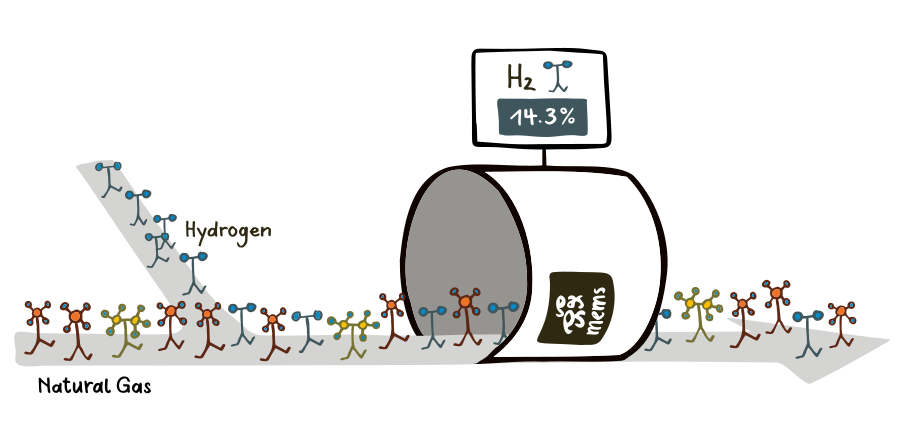
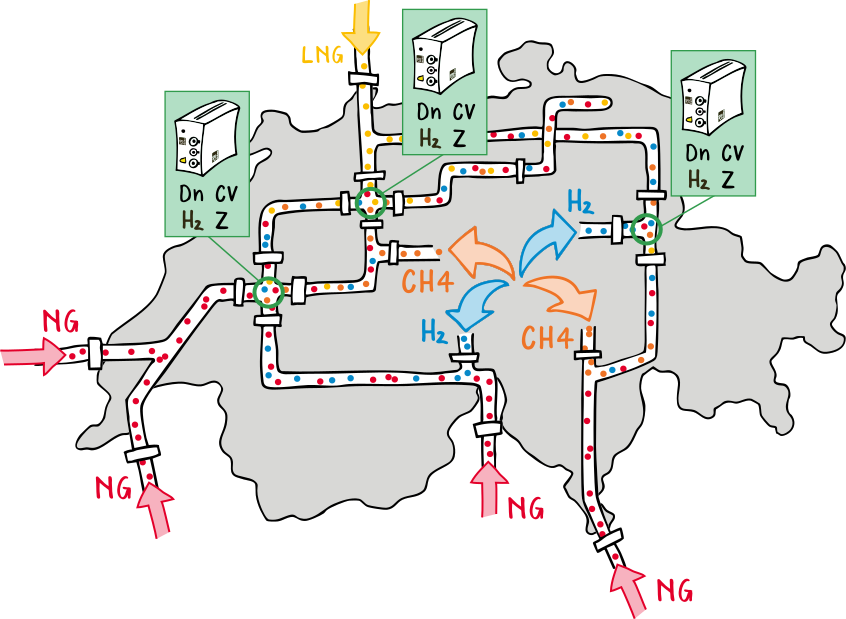
In gas distribution networks, accurate determination of gas quality and volume is essential for precise gas billing, safe operation, and H₂-readiness. As the digitization of gas networks accelerates and hydrogen blending becomes more common, the need for distributed, low-maintenance gas quality sensors is growing rapidly. Traditional gas chromatographs (GCs) are often expensive, require intensive maintenance, and are unsuitable for decentralized measurement - the gasQS™ flonic is the cost-effective and future-proof alternative.

The solution: gasQS™ flonic
The gasQS™ flonic measures calorific value, net calorific value, Wobbe index, hydrogen content, and other gas parameters with high precision - while requiring minimal maintenance, providing real-time data, and at a fraction of the cost of a gas chromatograph.
The gasQS™ flonic NG is OIML R140-certified and thus approved for metrology-compliant energy billing - even in networks with up to 23 mol% hydrogen. With an energy consumption of less than 1.5 W, it is ideal for decentralized continuous operation.
Gas Engines & Gas Turbines
Maximum Efficiency Through Precise Gas Quality Measurement

Do you know the quality of the gas that powers your plant?
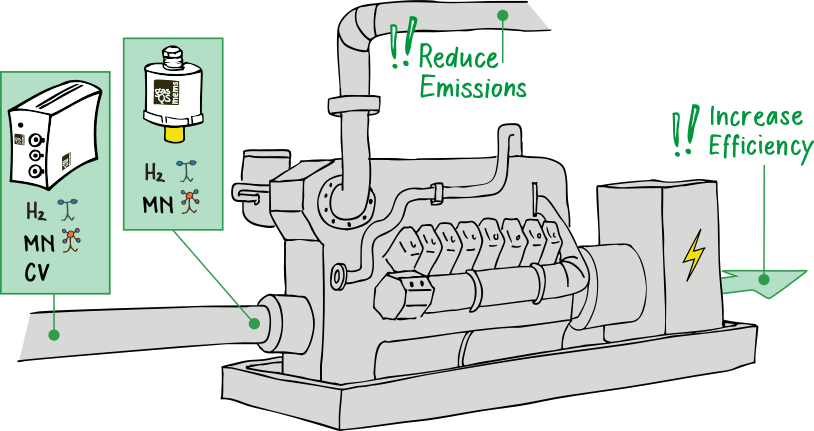
The efficiency of gas engines and gas turbines depends directly on gas quality. Without real-time data, heat-value-based control is not possible - leading to inefficient operation, increased wear and tear, and unnecessary emissions. Since gas quality fluctuates continuously depending on the source and admixtures, continuous measurement is essential.
The gasQS™ flonic and gasQS™ static provide precise real-time data on gas quality, enabling combustion-based engine control, automatic adjustment of the ignition timing, and emission reduction in gas engines and burners. This is particularly important when operating with hydrogen mixtures, as fluctuations in gas composition have a direct impact on the combustion process.
Real-world example: One sensor improves 20 gas engines
At the Kiel Coastal Power Plant, a single gasQS™ flonic optimizes the operation of 20 gas engines simultaneously, with efficiency gains that have paid for the investment within just a few months. It has been in operation for over six years - without any intervention.
Biogas plants
Efficient Biomethane Production with Precise Sensor Technology
Sustainability requires precision
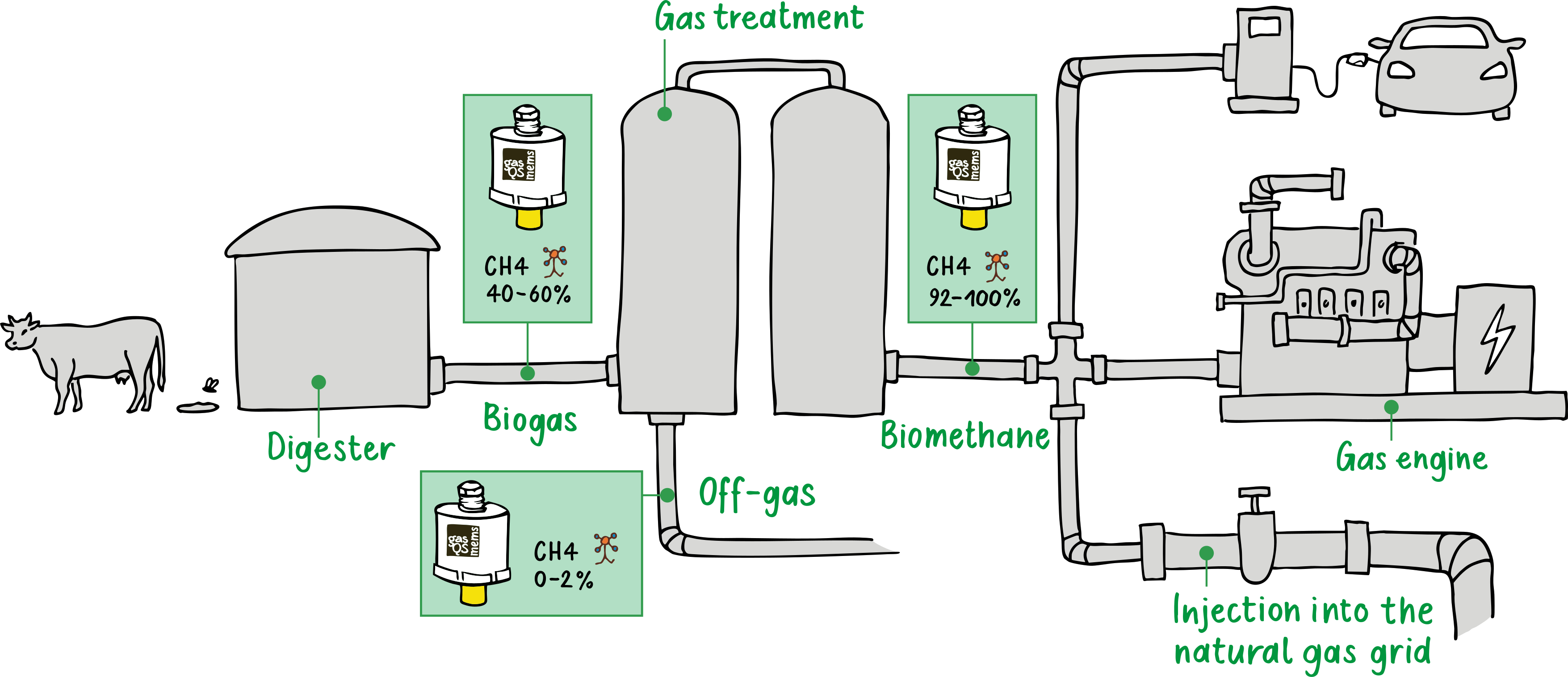
Biogas is a key technology in the energy transition and a foundation for power-to-gas (P2G) and methanation processes. But ensuring quality remains a challenge for many operators:
- Does your biomethane meet the standards of the gas grid?
- How can methane fluctuations be detected early and plant operations optimized?
- How can feed-in monitoring and billing at the grid connection point be reliably automated?

The answer: gasQS™ static
The maintenance-free inline sensor for fast and reliable methane detection in biomethane and off-gas.
- ATEX certified – safe to use directly in the plant.
- T90 of 1–2 seconds – instantly detects methane fluctuations.
- Maintenance-free & durable – no sensor wear, no drift.
- Cost-efficient and easy to integrate.
Ammonia Cracking
From ammonia back to hydrogen – monitored in real-time

Hydrogen via ammonia – precision where it counts
Ammonia is emerging as a key carrier for renewable hydrogen: energy-dense, non-explosive, and easy to transport as a liquid. But recovering that hydrogen through thermal cracking demands reliable, real-time gas analysis:
- How do you monitor cracking efficiency to protect downstream fuel cells and process components?
- How do you ensure the H₂/N₂ mixture meets quality requirements – continuously and without the need for calibration?
The answer: gasQS™ static – Ammonia Cracking
The maintenance-free sensor for fast and precise measurement of hydrogen and ammonia in cracker gas.
- ATEX & IECEx certified – safe for use in explosive atmospheres (Ex ia IIC T4 Ga).
- T90 approx. 2 seconds – real-time process control of the cracking process.
- Measures H₂ (0–75 mol%) and NH₃ (0–100 mol%) with ±0.2% accuracy.
- Pressure-compensated & maintenance-free – no reference gases, no moving parts.
- Simple 4–20 mA two-wire integration – no complex gateways required.

H2 purity measurement
Precise purity measurement of 95-100 mol% H₂

The Challenge: Hydrogen Purity
Hydrogen is a demanding energy source - even the slightest impurities can have a significant impact on efficiency and safety. In fuel cell applications, ultra-high-purity hydrogen is required in accordance with ISO 14687 to protect catalysts and maintain system efficiency. In industrial processes - such as chemical production or metal processing - deviations from purity specifications can impair process performance or pose safety risks.
Hydrogen is often present in mixtures with nitrogen, oxygen, air, or argon. Precise measurement of H₂ concentration - whether at high purity levels (95–100 mol%) or in trace amounts (0–5 mol%) - requires measuring instruments that are simultaneously precise, robust, and maintenance-free. Continuous real-time monitoring is essential here, as even the smallest deviations can quickly lead to operational, economic, or safety-related problems.
The Solution: gasQS™ static – Robust, Fast, Maintenance-Free
Thanks to its proven thermal conductivity measurement technology, the gasQS™ static monitors hydrogen purity precisely and continuously in real time.
Applications:
- Hydrogen purity measurement (95–100 mol% H₂, ±500 ppm accuracy).
- Detection of 0–5 mol% H₂ in N₂, O₂, air, or argon.
- Reliable performance across industrial and energy applications.
Key Benefits:
- ATEX / IECEx certified for Zone 0.
- Fast response time (T90: 1–2 s).
- Pressure compensated up to 15 barg.
- Maintenance-free, long-term stable sensor.
- No calibration, no consumables, no drift.
- Low energy requirements.
- Easy integration via 4–20 mA output.
For hydrogen production and utilisation alike, the gasQS™ static ensures safe, efficient, and reliable operations.