
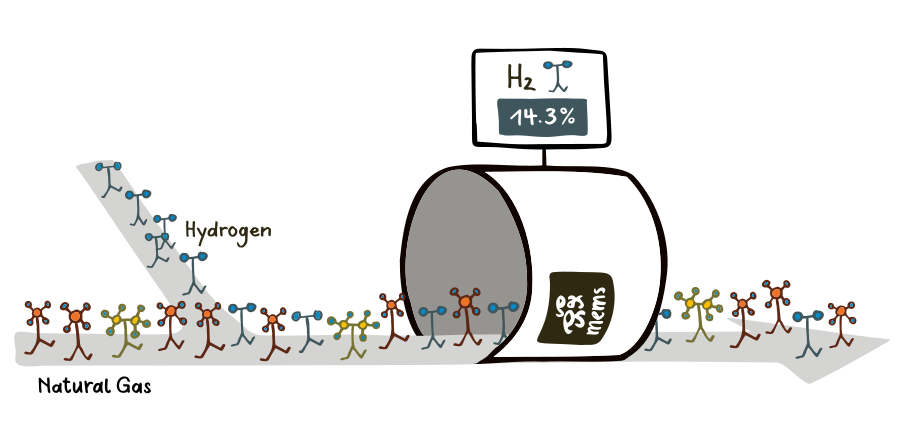
The efficient use of hydrogen blended into natural gas requires the right measurement technology — and correlative instrumentation can help
Interest in hydrogen as an energy carrier has been steadily increasing over the last decade, with many studies being performed into its generation, transport, storage, and use. The reason for the interest is clear: hydrogen is a carbon-free fuel that can be produced with renewable energy and combusted like natural gas. However, the physical properties of hydrogen are considerably different from those of natural gas, which prevents it from being a direct replacement. The blending of hydrogen into existing natural gas pipelines (typically up to 20% by volume) is being investigated in numerous countries as a way to reduce CO₂ emissions. This solution has the advantages of continued use of the existing infrastructure (transport, distribution and end-use), and resilience to variations in hydrogen production and availability.
Hydrogen Blending
The main issues with hydrogen blending result from the aforementioned differences between hydrogen and natural gas. Hydrogen has a higher flame temperature, considerably higher flame speed and lower air requirement for combustion, meaning that substantial efficiency gains can be achieved by optimising combustion processes for gas composition. Furthermore, the volumetric energy content of hydrogen is approximately one third of that of natural gas. As such, knowledge of the hydrogen content is not only key to efficiency gains for combustion processes, but also fair billing of gas consumption. With hydrogen injection and blending likely distributed throughout the network, this means that not only large temporal, but also spatial variability in hydrogen content can be expected.
Measurement
In this scenario, the need for determining the hydrogen content is clear, however the requirements on the instrumentation and sensors are quite high. Reference level instruments for gas quality determination, such as gas chromatographs, are often too expensive, complicated, or slow for many end-users. This has opened the door for other specialised instruments employing correlative principles, which infer (or correlate) a property of the gas mixture based on the measurement of one or more other gas properties such as thermal conductivity, heat capacity, speed of sound or density.
For applications involving hydrogen, correlative measurements function exceedingly well, as the physical properties of hydrogen differ greatly from those of natural gas. Correlative measuring instruments often have surprising benefits: they seldom require recalibration, are nearly immune to poisoning, absolute measurement accuracy is not tied to gas concentration, and they can be employed for virtually any concentration range.

The gasQS™ static
The gasQS static from Mems AG is an example of a correlative measuring instrument that operates on the principle of thermal conductivity measurements. Through laboratory calibration the thermal conductivity is equated to the concentration of hydrogen in the gas, which is returned as a 4-20 mA signal. The static is employed in the regulation of gas motors (ignition timing) and burners (power and air flow regulation), in hydrogen blending stations and for tracing hydrogen concentrations through distribution networks. The fast reaction time (T90 of 2 seconds), direct pipeline connection and no venting of gas are particularly valued characteristics for these applications.
Learn more about the gasQS™ static or get in touch to discuss your application.